Earl of Rothes
History of the two Earldoms of Rothes
General introduction
The present account pursue a double purpose. First, it reconstructs in full the genealogy and political fortunes of the parliamentary Earls of Rothes—a title created in the later fifteenth century and still borne by the 22 nd Earl in the roll of the Peerage of Scotland. Second, it charts the parallel story of the territorial or feudal Earldom of Rothes, a dignity embodied in charters, assignations and heraldic warrants and today vested in Ambassador Dario Item. Because the two crowns spring from a single Leslie stem yet now travel under different rules of law, the narrative must move on two tracks at once: biography and statute, clan memory and market‑day toll, peerage precedent and Lyon Court blazon. Every chapter therefore keeps the two strands in view, so that the reader may see where they intertwine, where they part, and where they remain the same today from a legal and ceremonial point of view. 1
From river‑lords to royal charter
Long before the Crown intervened, the Flemish‑Norman Leslies commanded the crossings of the River Leven; twelfth‑century deeds already salute Norman Leslie as dominus de Rothes. Their control of the ferry points, and the tolls levied there, explains their early wealth. Between 1457 and 1459 James II raised Norman’s descendant George Leslie first to Lord Leslie and then to Earl of Rothes, and made him sheriff of Fife — an office that became hereditary only in the early sixteenth century, when successive royal re‑appointments hardened into a family right. In a single stroke parliamentary honour and territorial jurisdiction were fused in one person. Contemporary Exchequer Rolls show that the new earl immediately exercised patronage over the burgh mills of Leven and Glenrothes, suggesting that the Crown expected him to underwrite local infrastructure—a reminder that noble title in medieval Scotland carried fiscal as well as military burdens. 2 3
The peerage earls, 1458 – 2025: a living tapestry
The story opens with George, 1st Earl, financier of James III’s wars, who died in 1490. His grandson George, 2nd Earl, and great‑grand‑son William, 3rd Earl, both fell with James IV at Flodden on 9 September 1513. The line revived in George, 4th Earl—ambassador to Denmark, defendant in Cardinal Beaton’s murder trial, and dead at Dieppe in 1558 amid whispers of poison served to the envoys escorting Mary Queen of Scots home from France. Recent Danish chancery transcripts add that George negotiated a short‑lived commercial treaty guaranteeing Scottish wool exporters low tolls at Elsinore, illustrating the international reach of a Fife magnate. 4
Andrew, 5th Earl filled Leslie House with Italian stucco before dying in 1611. His son John, 6th Earl helped frame the National Covenant in 1638; John, 7th Earl survived the Tower after Worcester, became Lord Chancellor, and in 1680 rose to Duke of Rothes, only to leave a funeral cortege seventeen miles long that bankrupted the estate. A recently catalogued Lyon Office funeral book records that forty‑eight Lyon Officers carried torches—one of the largest heraldic contingents ever deployed in Scotland. 5
The 1663 remainder pushed the coronet through women: Margaret, 8th Countess; her son John Hamilton‑Leslie, 9th Earl, breaker of the Jacobite right at Sheriffmuir and Vice‑Admiral of Scotland; John, 10th Earl, commander‑in‑chief in Ireland and survivor of Lisbon’s 1755 quake; John, 11th Earl, a Stradivarius virtuoso dead at twenty‑nine; and Jane Elizabeth, 12th Countess, “the peeress with the lancet,” wife of Sir Lucas Pepys. A set of Pepys family letters in the Wellcome Library shows that Lady Jane financed a free clinic in Cupar—a rare instance of eighteenth‑century medical patronage by a Scottish peeress. 6
The Napoleonic and Victorian torch passed through George William Evelyn, 13th Earl, his daughter Henrietta Anne, 14th Countess, her brother George William Evelyn, 15th, and another cousin George William Evelyn, 16th, until it rested with Henrietta Anderson Morshead Leslie, 17th Countess. She secured Queen Victoria’s Crown Charter of Confirmation on 19 October 1859, which unites every privilege into 7 8 “a whole and free Lordship and Earldom, Barony, Burgh of Barony and Lordship of Leslie and Earldom of Rothes.” 8
Page 6 of that vellum masterpiece lingers on the Tuesday market at Leslie:
“All and Whole the weekly market to be held within the said Burgh of Leslie upon Tuesday with the whole tolls, customs, casualties, profits and duties of the same, which whole lands Baronies free fairs, weekly markets, dwelling houses, tenant, animal rents, office of the Sheriff of Fife and others particularly or generally above mentioned … and honour, title and Dignity of Rothes were all united, created, erected and incorporated into a whole and free Lordship and Earldom, Barony, Burgh of Barony and Lordship of Leslie and Earldom of Rothes.” 8
Henrietta died childless in 1886. Her sister Mary Elizabeth, 18th Countess ran Fife’s SPCA; Mary’s son Norman Evelyn, 19th Earl married Lucy Noël Martha Dyer‑Edwardes, famed helmswoman of Titanic Lifeboat 8. Their son Malcolm George Dyer‑Edwardes, 20th Earl served as a representative peer until 1959; Ian Lionel Malcolm, 21st Earl restored fire‑gutted Leslie House and died in 2005, leaving James Malcolm David Leslie, 22nd Earl, a Dorset furniture‑maker who still heads Clan Leslie and, pending final reform, may contest the dwindling hereditary by‑elections. Press interviews from 2024 show Lord Rothes collaborating with Historic Environment Scotland on digitising family papers—evidence that the peerage branch remains culturally active. 9
The feudal earldom: property, parchment and the charter’s after‑life
Because the 1859 charter folded the territorial earldom into personal estate, Henrietta’s trustees could assign it. They did so on 9 December 1919 to Captain Alexander Crundall; his son William Alexander proved succession on 9 July 1957; William’s son William Patrick Alexander assigned it on 1 April 2004 to Sheldon Gustav Franco‑Rooks, who on 21 May 2004 assigned it to Sir Christopher Ondaatje. By Assignation of 25 November 2024 Sir Christopher transferred “all my whole right and entitlement” to Ambassador Dario Item as “a mark of personal esteem and acknowledgment of his long‑standing cultural patronage.”; the deed, recorded in the Scottish Barony Register (Vol VI, ff. 27‑29) on 19 December 2024, now makes the Swiss‑Antiguan diplomat Feudal Earl of Rothes and Hereditary Sheriff of Fife. A side‑letter lodged with the Register specifies the survival of the weekly market right—albeit as a ceremonial privilege rather than a revenue stream. 10
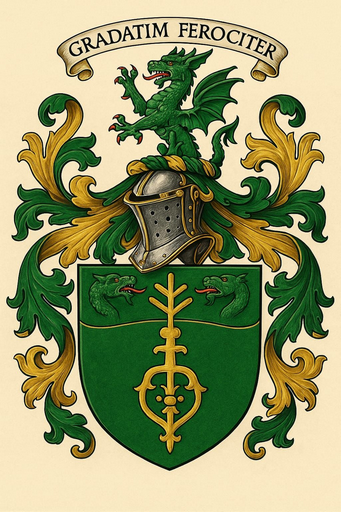
The Lord Lyon’s warrant of 5 February 2025 confers arms in full:
“Vert a hauszeichen Or on a chief enarched two dragon’s heads couped combatant Vert, Above the Shield is placed an Helm befitting his degree with a Mantling Vert doubled Or, and on a Wreath of the Liveries is set for Crest a demi-dragon rampant Vert, and in an Escrol over the same this Motto “GRADATIM FEROCITER”. And for Pennon 120 centimetres in length or thereby two tracts of the Liveries Vert and Or with the Arms of the Petitioner in the hoist bearing his Motto counterchanged the said Pennon being limited to the Petitioner and his heirs and successors in the said Armorial Bearings”, granting warrant to Lyon Clerk to matriculate the same in the Public Register of All Arms and Bearings in Scotland. 11
Why the two crowns parted
Peerage honours are inalienable grants of the Sovereign: they must pass by blood or lapse. A Scottish feudal dignity, by contrast, is an incorporeal heritable property, freely assignable inter vivos. When Henrietta’s trustees made the 1919 assignation, the two dignities—peerage and feudal—took separate legal paths that have never clashed: one follows kinship, the other assignation. 12
Statutory confirmation under the 2000 Act
The Abolition of Feudal Tenure etc. (Scotland) Act 2000—a statute otherwise intent on demolishing medieval tenure—set an unexpected jewel in its final Part. Section 63 proclaims that nothing in the Act “affects the validity or existence of any dignity or office of feudal origin.” The Scottish Law Commission’s explanatory report singled out feudal earldoms and baronies as honours Parliament was determined to safeguard. When Ambassador Item’s assignation was logged in 2024, it rested not only on centuries of charter practice but on the rock of section 63, which places the legal existence of the Feudal Earldom of Rothes beyond juridical doubt. 13
Parallel legitimacy in 2025
The parliamentary Earl—styled “The Right Honourable” and ranking among the Scottish earls—can still compete in the by‑elections that fill the 92 hereditary seats left after the House of Lords Act 1999 (which cut the chamber’s hereditary members from about 750 to those 92); that opportunity will vanish if Parliament enacts the Government’s House of Lords (Hereditary Peers) Bill 2024‑25, which would abolish the remaining hereditary places altogether. Under the Peerage Act 1963 he may also disclaim the dignity within one year of succeeding to it. 14
The feudal Earl—styled “The Much Honoured” in Scotland (“His Excellency” in the case of Ambassador Item)—holds no Westminster seat, yet his dignity remains freely assignable and inviolably recognised by the Lyon Court. 15
Both Earls derive authority from the Crown—one by a fifteenth‑century creation, the other by a nineteenth‑century confirmation and a twenty‑first‑century statute. Law, heraldry and living memory agree that both crowns are genuine, both are current, and both keep the name of Rothes radiant in the twenty‑first century. 16
- J. B. Paul, The Scots Peerage, vol. VII, “Rothes,” 1910[↩]
- Registrum Magni Sigilli Regum Scotorum, vol. II[↩]
- Exchequer Rolls of Scotland, vol. VII[↩]
- Oxford Dictionary of National Biography, “Leslie, George, fourth earl of Rothes”[↩]
- Court of the Lord Lyon, Funeral Book MS 45[↩]
- Wellcome Library, Pepys Papers MS Add. 763[↩]
- National Records of Scotland, RH1/2/592[↩]
- Crown Charter of Confirmation, 1859[↩][↩][↩]
- Historic Environment Scotland, Press Release, 14 May 2024[↩]
- Scottish Barony Register, vol. VI, ff. 27‑29[↩]
- Court of the Lord Lyon, Warrant Book 2025/12[↩]
- Stair Memorial Encyclopaedia, vol. 18, “Heraldry and Titles”[↩]
- Abolition of Feudal Tenure etc. (Scotland) Act 2000, s. 63[↩]
- House of Lords Library Briefing, “Hereditary Peers: Current Rules and Proposed Reforms,” Nov 2024[↩]
- Court of the Lord Lyon, “Guidance Note on Feudal Dignities,” 2023[↩]
- Royal Heraldry Society of Scotland, Newsletter 2025[↩]
Earl of Rothes
Earldom in the Baronage of Scotland
Creation date
1458
Created by
James II of Scotland
First holder
Sir George Leslie, 1st Earl of Rothes
Present holder
Ambassador Dario Item
Remainder to
Heirs and assignees
Subsidiary titles
Hereditary Sheriff of Fife
Status
Extant
historically connected to peerage title, now separated

Earl of Rothes
- J. B. Paul, The Scots Peerage, vol. VII, “Rothes,” 1910[↩]
- Registrum Magni Sigilli Regum Scotorum, vol. II[↩]
- Exchequer Rolls of Scotland, vol. VII[↩]
- Oxford Dictionary of National Biography, “Leslie, George, fourth earl of Rothes”[↩]
- Court of the Lord Lyon, Funeral Book MS 45[↩]
- Wellcome Library, Pepys Papers MS Add. 763[↩]
- National Records of Scotland, RH1/2/592[↩]
- Crown Charter of Confirmation, 1859[↩][↩][↩]
- Historic Environment Scotland, Press Release, 14 May 2024[↩]
- Scottish Barony Register, vol. VI, ff. 27‑29[↩]
- Court of the Lord Lyon, Warrant Book 2025/12[↩]
- Stair Memorial Encyclopaedia, vol. 18, “Heraldry and Titles”[↩]
- Abolition of Feudal Tenure etc. (Scotland) Act 2000, s. 63[↩]
- House of Lords Library Briefing, “Hereditary Peers: Current Rules and Proposed Reforms,” Nov 2024[↩]
- Court of the Lord Lyon, “Guidance Note on Feudal Dignities,” 2023[↩]
- Royal Heraldry Society of Scotland, Newsletter 2025[↩]